

Melhem Hachem
The audience does not leave “Al Wahish” with a single settled impression. What remains is a suspended state of uncertainty, as if the performance resists closure and refuses to be reduced to a fixed judgment. The experience continues to unfold after the curtain falls, shifting the focus from evaluation to lingering psychological residue.

In Jacques Maroun’s staging at Theatre Le Monnot, the work operates less as a straightforward adaptation of John Patrick Shanley’s text and more as an exercise in compressing human relations under extreme pressure. The dramaturgical space is reduced to its most severe form, a closed confrontation between two individuals stripped of emotional distance and protective layers.
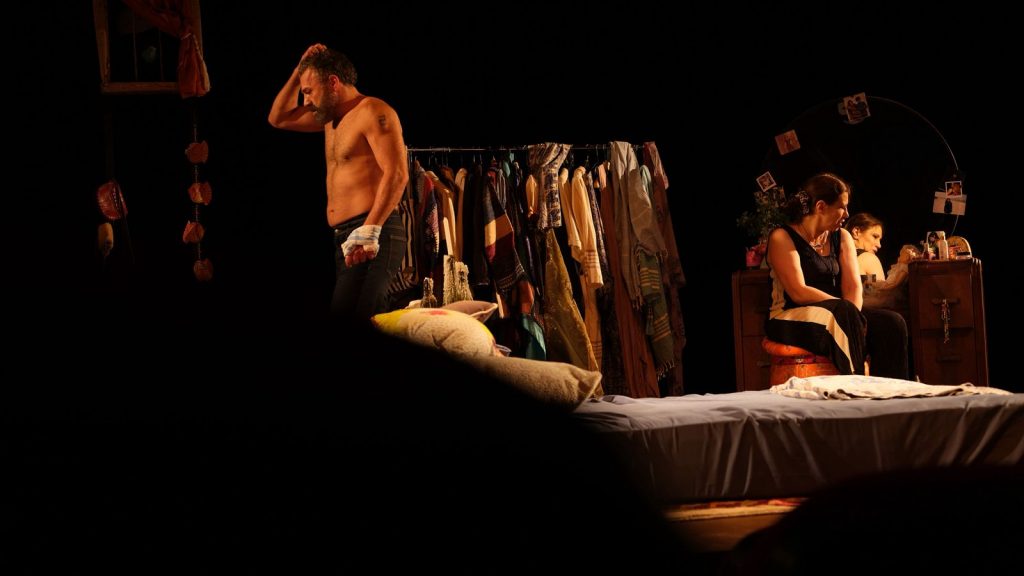
Within this frame, Danny, played by Dory El Sammarani, emerges not as a conventional figure of anger but as a body in constant friction with itself, suspended between impulse and collapse. Bertha, performed by Carol Abboud, is shaped as a saturated interiority, where memory overwhelms the present and internal judgment replaces external reality.

What distinguishes the performance is the absence of traditional escalation. Rather than progressing through clear dramatic steps, the piece moves through gradual erosion, where stability dissolves and interpretation becomes increasingly unstable. Tension replaces narrative clarity as the main structural force.
Directorially, Maroun compresses the space to intensify proximity between the characters, yet this spatial concentration is not always supported by a consistent rhythmic architecture. High intensity sequences are followed by abrupt reductions in pressure, creating an uneven pulse that affects the coherence of the overall experience.
In terms of performance, Dory El Sammarani delivers a physically charged interpretation that clearly conveys a body on the edge of rupture, though the psychological transformation does not always reach full depth and occasionally remains at the level of external expression. Carol Abboud approaches Bertha through a restrained internal register, yet some moments remain anchored to a recognisable performance vocabulary rather than complete dissolution into the character.
The writing itself relies on accumulation rather than economy. This choice gives the text density, but at times it replaces discovery with declaration, reducing the sense of unfolding that theatre usually depends on.
Even the visual language, though strong at its inception, does not consistently sustain its initial tension throughout the duration of the work. The production succeeds more in establishing a powerful opening atmosphere than in maintaining a continuous dramaturgical arc.
Still, what persists is not the structure of the performance but the unsettling idea it leaves behind. “Al Wahish” does not present the beast as an external figure, but as an internal condition, a possibility that emerges when human balance collapses. A work that does not ask for agreement, but instead reopens a more difficult question about what it means to confront the fragile limits within ourselves.