
Ryan Hachem
Currently showing at Grand Cinemas, Clayface transforms a story about a man’s physical disfigurement into a chilling exploration of identity, obsession and the price of trying to reclaim a lost self. Directed by James Watkins, the film is written by Mike Flanagan and Hossein Amini, from a story by Flanagan. It stars Tom Rhys Harries as Matt Hagen, alongside Naomi Ackie, David Dencik, Max Minghella, Eddie Marsan, Ruby Sear, Nancy Carroll and Joshua James. Produced by DC Studios and 6th & Idaho Productions, in association with Domain Entertainment, the film is distributed by Warner Bros. Pictures.
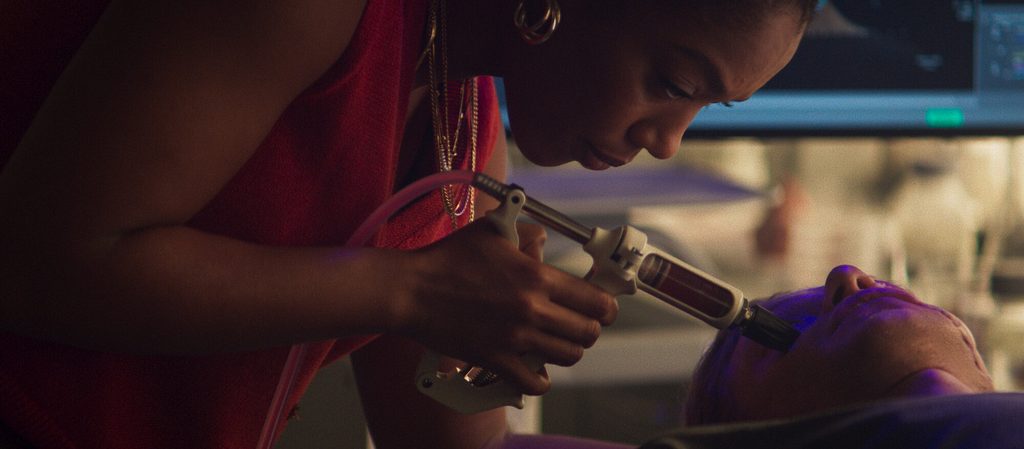
Matt Hagen is a rising Hollywood actor whose career is shattered by a brutal attack that leaves him horribly disfigured. Desperate to recover his former life, he turns to Dr. Caitlyn Corr (Ackie), whose experimental treatment promises to restore his appearance. The results are extraordinary, but the transformation comes at a devastating cost: as Matt regains his face, his grip on reality begins to unravel, drawing him towards a path of violence and revenge.
When the Body Becomes the Horror

Watkins approaches the story through body horror, making physical transformation central to the film’s unease. Flesh becomes unstable, familiar features lose their permanence, and the human body emerges as both a source of identity and something frighteningly unpredictable. The visual effects and makeup reinforce this unsettling atmosphere, giving Matt’s transformation a disturbing physical presence rather than treating it merely as a supernatural spectacle.
Yet the film’s most intriguing dimension lies beneath the horror. Matt’s face is more than his appearance: it represents his career, his place in the world and the person he believes himself to be. His attempt to recover it raises a compelling question about how much of our identity depends on how others see us—and what remains when that image begins to disappear.
A Man Behind the Monster
Tom Rhys Harries anchors the film with a performance shaped by vulnerability and desperation. Matt is not simply becoming a monster; he is struggling to hold on to the person he remembers. Harries gives this conflict an emotional dimension, allowing the physical horror to reflect a deeper loss of control.
Naomi Ackie adds another layer through Caitlyn Corr, whose scientific ambitions become inseparable from the consequences of her treatment. Their relationship provides the story with a human centre, connecting the unsettling transformation to questions of responsibility, attachment and the desire to repair what has been broken.
The film is at its strongest when these personal conflicts and the body horror work together. Its central idea also lends itself to a broader reading of an industry obsessed with appearance, where the promise of reinvention can become a dangerous pursuit.
Between Transformation and Tragedy

As the story progresses, the focus shifts increasingly towards revenge and Matt’s emergence as a figure of menace. This gives the narrative momentum, although some of its psychological and emotional threads could have been developed further. At times, the film moves away from the intimate tragedy of a man losing himself towards more familiar horror conventions.
Even so, Clayface offers a distinctive take on a comic-book character by placing physical vulnerability and psychological deterioration at the heart of the story. Rather than relying solely on the mythology surrounding its central figure, it explores the unsettling distance between the person we believe ourselves to be and the one we may become.
Ultimately, Clayface is most compelling when it treats transformation not as a new power, but as the loss of something deeply human. Behind the changing face is a man trying to recover his former self—and discovering that the desire to become who he once was may be the very thing that destroys him.
For the latest movie schedule at Grand Cinemas, visit our website.