
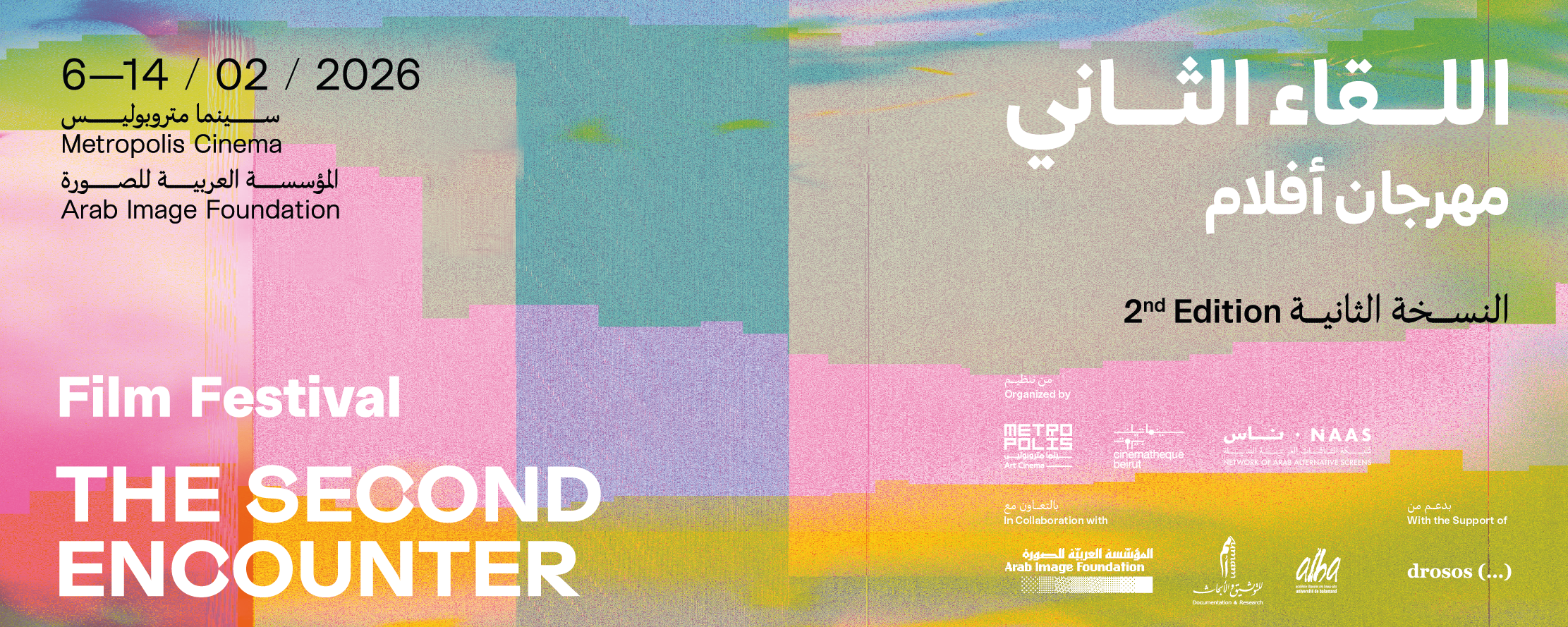
Organized within the framework of Metropolis’ Cinematheque Beirut project, The Second Encounter is a film festival dedicated to film archives and archival practices. To encounter archives today is to reflect on what it means to preserve, restore, restitute, and disseminate film and film-related materials in times and territories continuously unsettled by war and destruction. Entitled “After Absence”, this second edition focuses on works that propose different ways of engaging with loss, approaching archives beyond their function of documentation and resisting absence, in order to activate them as sites of political and social imagination.
Taking place over nine days, from 6 to 14 February 2026, the festival is organized in partnership with the Network of Arab Alternative Screens (NAAS) and with the support of the Drosos Foundation. It brings together seminal and newly restored films, alongside works that re-use archival material. Through screenings, performances, and talks, and an exhibition, the program foregrounds recent restoration efforts in the Arabic-speaking region and opens a space for exchange around current archival practices.
The program opens with the restored copy of Ghassan Salhab’s first feature film Beirut Phantom (1998) and closes with Mohamad Soueid’s My Heart Beats Only For Her (2008), creating a conversation between two filmmakers who have been shaping the cinematic landscape in Lebanon since the mid-1990s. The newly restored copy of Sudanese filmmaker Hussein Shariffe’s The Dislocation of Amber (1975) will be screened in dialogue with Pier Paolo Pasolini’s The Walls of Sanaa (1972) followed by a conversation with members from Cimatheque (Cairo) and Sudan Film Factory (Khartoum) to discuss what it means to make films and restore them in contexts of exile and devastation.
The festival has also partnered with UMAM D&R to highlight the work of pioneer Lebanese filmmaker and technical innovator Youssef Fahdeh, active in the 1950s. Musician Nour Sokhon will accompany fragments from his 1958 film Fil-Dar Ghariba in a cine-concert conceived by Ayman Nahleh, curator of the exhibition Youssef Fahdeh: A Story from Baalbeck Studios, which will open at UMAM D&R’s Hangar on the 9th of February. A case study with Association Jocelyne Saab and Cinematheque Beirut on the restoration of films by Jocelyne Saab and Georges Nasser will guide us through the skills, infrastructures, and partnerships necessary to preserve and restitute our own film heritage. This session will culminate in the screening of Jocelyne Saab’s Ghazl el Banet (1985), recently restored in Beirut by the Association from the 35mm positive conservation print belonging to the Canadian production company that supported the film, and held at the Cinémathèque québécoise.
Found footage practices occupy a central place in this edition’s program. From early and important experimentation such as Assia Djebar’s The Zerda and the Songs of Forgetting (1982) to more recent works such as Diana Allen’s Partition (2025), Mahasen Nasser-Eldin’s The Silent Protest (2019), Ghada Sayegh’s Meteores (2025), and Rana Abushkaidem and Mira Jibreen’s Wadi Foukin, Deir Hanna (2021), these works confront colonial and imperial archives, listening to what has been silenced and erased in order to transcend the violence they contain and perpetuate. In collaboration with the Arab Image Foundation, the festival will present One Image, Two Acts (2020) and Scenes of Extraction (2023) by Sanaz Sohrabi. Drawing on elements from the archives of British Petroleum (BP) during its operations in Iran, Iraq, and Kuwait, the films examine the entanglements between the political economy of photography, archival technologies, and the visual history of resource extraction in Iran.
We are also invited to navigate various archival fragments through Raphaël Grisey and Bouba Touré’s film Xaraasi Xanne (Crossing Voices) (2022), Lea Morin’s performance The Missing Cinema of Madeline Beauséjour, as well as an encounter with Ali Hussein Al-Adway, About Labor and the Archive, transporting us into the heart of the political and social struggles of the 20th century and cinema’s capacity to restitute these often marginalized narratives. Furthermore, personal archives and home videos become sites of inquiry in Three Promises (2024) by Youssef Srouji, The Wedding (2025) by Nour Kheir-Alanam, Karaoke (2015) by Raed Yassin, The Video Story (2015) by Vartan Avakian, and Who Was Here (2025) by Evi Stamou. The filmmakers excavate the multiple stories these intimate materials contain, suggesting alternative ways to experience our histories and realities.
In parallel to the festival, a closed symposium on archival practices, The Multiple Lives of Images, will bring together practitioners working in and around film archives in the Arabic-speaking region over three days. In partnership with the Académie Libanaise des Beaux-Arts (ALBA), a two-day workshop with archivist Chantal Partamian will be organized for university students as part of Cinematheque Beirut’s work in preserving Georges Nasser’s archives.